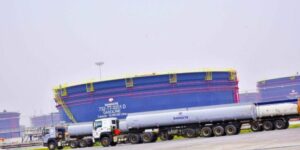
Nigeria’s largest refinery, the Dangote Petroleum Refinery, has reportedly scaled back petrol production following operational challenges linked to crude supply and equipment performance.
According to industry data cited by Reuters, the refinery’s gasoline-producing unit has been operating below its installed capacity since late May. The reduction was attributed to insufficient feedstock availability and technical issues affecting a critical component of the facility.
Industry monitor IIR Energy said the refinery initially struggled with the type of crude oil being processed, which limited the volume of feedstock required for optimal gasoline production. The situation was later compounded by a mechanical fault involving a flue gas slide gate valve within the refinery’s Residue Fluid Catalytic Cracking Unit (RFCCU), a major unit used in petrol manufacturing.
The consultancy noted that repairs on the faulty equipment are nearing completion and projected that full production rates could be restored by the middle of June.
Despite the temporary decline in output, there have been no immediate signs of fuel shortages or price increases in Nigeria. The development comes as global energy markets face renewed uncertainty amid rising geopolitical tensions in the Middle East, which have pushed crude oil prices higher.
The 650,000-barrel-per-day Dangote Refinery, which began full operations earlier this year, was established to reduce Nigeria’s dependence on imported petroleum products and strengthen the country’s refining capacity.
Export figures indicate that the refinery’s petrol shipments have fallen sharply in recent months. Data from commodities analytics firm Kpler showed that gasoline exports dropped significantly in May and June compared to the peak levels recorded in April.
The refinery has emerged as a key supplier of refined products within Nigeria and across regional markets, exporting diesel, aviation fuel and petrol to several countries. Its operations are widely viewed as central to Nigeria’s ambition of becoming a major refining and fuel-export hub in West Africa.
Industry observers will be watching closely to see whether the expected restoration of full production capacity leads to a rebound in export volumes and strengthens fuel supply across the region.