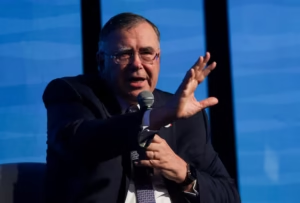
The Nigerian Midstream and Downstream Petroleum Regulatory Authority (NMDPRA) has urged African countries to establish a regional fuel pricing benchmark to reduce dependence on foreign indices and better reflect the realities of the continent’s evolving petroleum market.
Speaking in Abuja ahead of the second West Africa Refined Fuel Conference, NMDPRA Chief Executive, Rabiu Umar, said Africa’s growing refining capacity and expanding cross-border petroleum trade make it necessary for the region to develop an independent pricing system.
According to Umar, major energy markets across the world already operate regional pricing benchmarks that consider local supply, demand, transportation costs and market conditions. He argued that Africa should adopt a similar framework to improve price transparency, strengthen regional trade and attract greater investment into the downstream petroleum sector.
He explained that Europe, for example, relies on the Amsterdam-Rotterdam-Antwerp (ARA) trading hub as a key reference point for petroleum pricing and distribution, adding that West Africa could establish a comparable hub to serve the region’s energy market.
Umar noted that the continent’s increasing investment in domestic refining, particularly in West Africa, has created an opportunity to develop a pricing system based on regional production rather than international reference prices. He suggested that existing trading centres such as Lomé could eventually be joined or replaced by other regional hubs as the market develops.
The NMDPRA boss identified infrastructure as a major requirement for achieving an integrated petroleum market. He stressed that investments in pipelines, storage facilities, ports, marine terminals and logistics networks are essential to ensure refined products move efficiently across borders.
He cited the West African Gas Pipeline as an example of how regional infrastructure can improve energy integration by enabling gas produced in Nigeria to reach neighbouring countries including Ghana, Togo and Benin Republic.
Umar also pointed to inadequate port facilities, shallow harbour depths and limited pipeline networks as obstacles that continue to hinder petroleum trade within the region.
On fuel quality, he called for harmonised product specifications across African countries, saying differing standards make cross-border movement of petroleum products more difficult. He added that Nigeria currently produces cleaner fuels than several neighbouring markets, noting that locally refined products meet stricter sulphur content requirements.
He further stated that the operations of the Dangote Petroleum Refinery have improved fuel availability in Nigeria and neighbouring countries, even during periods of global supply disruptions, including recent tensions affecting the Strait of Hormuz.
The conference, scheduled to hold in Abuja on August 11 and 12, is being organised by the NMDPRA in collaboration with S&P Global Commodity Insights and the West Africa Regulators Forum. It will focus on mobilising investment for critical downstream infrastructure and advancing discussions on creating a transparent regional petroleum pricing and trading hub.
According to the authority, the inaugural edition of the conference led to the establishment of the West Africa Regulators Forum, the publication of regional reference prices and the opening of S&P Global Commodity Insights’ regional office in Abuja.
The regulator said this year’s event will explore investment opportunities across pipelines, storage terminals, marine infrastructure, LNG facilities, digital commodity exchanges, logistics corridors and strategic petroleum reserves, with the goal of strengthening Africa’s downstream petroleum value chain and supporting the development of a credible regional fuel pricing benchmark.