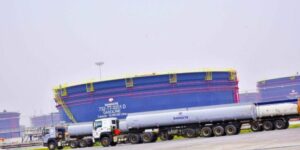
Nigeria’s petrol supply pattern has shifted significantly towards local refining, with domestic refineries accounting for about 75 per cent of the country’s petrol supply between January and July 2026.
Data from the Nigerian Midstream and Downstream Petroleum Regulatory Authority analysed over the seven-month period showed that local refineries supplied approximately 7.41 billion litres of Premium Motor Spirit, compared with 2.48 billion litres imported into the country.
The figures represent a major change from the same period in 2025, when Nigeria imported about 6.58 billion litres of petrol while domestic refineries supplied roughly 4.27 billion litres.
Consequently, the contribution of local refineries to total petrol supply increased from 39.4 per cent in January-July 2025 to 74.9 per cent in the corresponding period of 2026. The share of imports fell from 60.6 per cent to 25.1 per cent.
The growth in domestic refining was largely driven by the increased production of the Dangote Petroleum Refinery, alongside output from other local facilities.
Despite the stronger performance of domestic refineries, total petrol supply declined during the period. Nigeria received about 9.89 billion litres of PMS in the first seven months of 2026, compared with approximately 10.85 billion litres during the same period in 2025.
Local production also experienced considerable fluctuations during the year. Domestic refinery supply averaged 40.1 million litres per day in January before dropping to 29.4 million litres in February. It subsequently recovered to 34.2 million litres in March, 40.7 million litres in April and a peak of 41.5 million litres per day in May.
Production weakened considerably afterwards, falling to 32.5 million litres daily in June and 25.8 million litres in July.
Meanwhile, petrol imports increased during the latter part of the period as local output declined. In July, domestic refineries supplied nearly 800 million litres, equivalent to an average of 25.8 million litres daily, while imports contributed about 611 million litres.
The figures indicate that although Nigeria has substantially reduced its reliance on imported petrol, imported products remain important whenever local refinery production falls.
The development comes amid continuing disagreements within the downstream petroleum sector over crude supply, petrol imports and market competition. The Dangote refinery has previously raised concerns about securing adequate crude feedstock and access to foreign exchange.
The refinery’s management has also indicated that some petroleum products are being directed towards export markets amid challenges associated with crude procurement and dollar liquidity.
Industry stakeholders have meanwhile called for a review of petrol importation policies. The Independent Petroleum Marketers Association of Nigeria argued that continued importation was not achieving its intended purpose of moderating domestic fuel prices, particularly where imported petrol was more expensive than locally refined products.
The latest data nevertheless point to a fundamental change in Nigeria’s fuel market. Domestic refineries now provide the majority of the country’s petrol requirements, although the volatility in local production highlights the need for steady crude supplies, reliable refinery operations and improved access to foreign exchange.