Africa is on the verge of a major transformation in its oil and gas sector, with new refinery projects expected to boost production capacity and attract massive investments, according to the Organisation of Petroleum Exporting Countries (OPEC).
In its latest World Oil Outlook 2025, OPEC projects that Africa could add up to 1.2 million barrels per day (bpd) in refining capacity by 2030, making it one of the fastest-growing regions in the downstream sector.
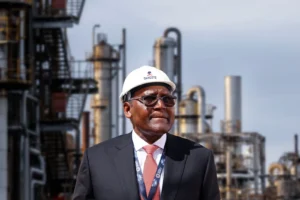
Leading this growth is Nigeria, where the 650,000-bpd Dangote Refinery—already operational—has begun reshaping fuel trade across the continent. Other significant Nigerian projects include the 200,000-bpd Akwa Ibom Refinery, while Angola is pushing ahead with the Lobito (200,000 bpd) and Soyo (100,000 bpd) refineries. Uganda is also pressing forward with its 60,000-bpd Hoima Refinery as part of the Lake Albert basin development plan.
Beyond these large-scale facilities, smaller modular refineries are emerging in countries like Ghana, Guinea, Congo, and Nigeria. These modular plants, though smaller, are seen as flexible and scalable solutions in regions facing financial and infrastructure challenges.
North Africa is also positioning itself strongly. Algeria, Libya, and Egypt are working on key projects designed to improve domestic supply, secure higher refining margins, and reduce their dependence on imported fuel.
OPEC estimates that Africa will require over $40 billion in refinery investments before 2030 to achieve its goals. Longer-term, the continent could need an additional $60 billion for new construction, modernization, and capacity upgrades, creating a potential $100 billion investment opportunity for global investors, sovereign wealth funds, and energy-focused financiers.
The report highlights that Africa, along with the Asia-Pacific and Middle East, will dominate new refinery additions up to 2050. Rising fuel demand is also expected to play a major role, with Africa’s domestic crude consumption forecast to jump from 1.8 million bpd in 2024 to 4.5 million bpd by 2050. This will likely reduce the continent’s crude exports by more than one million bpd, marking a decisive shift toward building stronger internal value chains.
According to OPEC, this refining expansion is not just about boosting capacity—it signals a turning point for Africa’s energy independence and competitiveness. If fully realized, the continent could move away from its traditional role as a raw crude exporter to become a resilient, integrated, and investment-friendly energy hub.