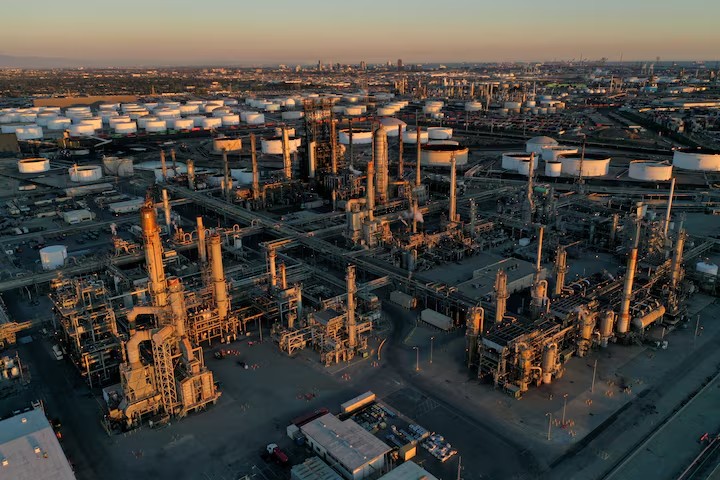
Nigeria’s refining sector continues to face significant challenges, operating well below its installed capacity, the Federal Government has revealed. According to the Nigerian Midstream and Downstream Petroleum Regulatory Authority (NMDPRA), refinery utilisation between January and September 2025 was just 61.6 per cent.
The regulator said low output is linked to technical problems, limited crude supply, and repeated downtime at government-owned refineries. Currently, only four refineries—Dangote, Aradel, Edo, and Waltersmith—are actively producing, with a combined operational capacity of 467,000 barrels per day.
Dangote Refinery, the country’s largest with a capacity of 650,000 barrels per day, processed 449,000 barrels daily in October, falling short of its full potential despite plans to increase output to 1.4 million barrels per day.
State-owned refineries in Port Harcourt, Warri, and Kaduna remain under phased rehabilitation, while smaller modular refineries such as Waltersmith, Duport, Edo, OPAC, and Aradel operate at capacities ranging from 1,000 to 11,000 barrels per day.
Since 2000, the government has issued 47 Licences to Establish (LTEs) for refineries, totaling 1.75 million barrels per day, and granted 31 Licences to Construct (LTCs) for facilities with planned capacity of 1.228 million barrels per day. However, only three refineries are currently under construction, including Waltersmith Train 2 (5,000bpd), AIPCC (30,000bpd), and Azikel (12,000bpd).
Industry stakeholders say the gap between planned capacity and actual production is largely due to crude supply challenges. Eche Idoko, National Publicity Secretary of the Crude Oil Refinery-Owners Association of Nigeria (CORAN), explained that investors struggle to advance projects without guaranteed feedstock.
Dolapo Okulaja, CORAN Vice-Chairman, added that many local refiners are not receiving enough crude to operate efficiently, despite provisions in the Petroleum Industry Act (PIA). CORAN President Momoh Oyarekhua also noted that conflicting clauses in the PIA have complicated domestic crude supply arrangements, undermining the law’s goal of supporting local refining.
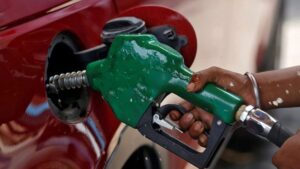
The NMDPRA has pledged to intensify regulatory oversight as Nigeria pushes to reduce petrol imports and strengthen local supply chains.