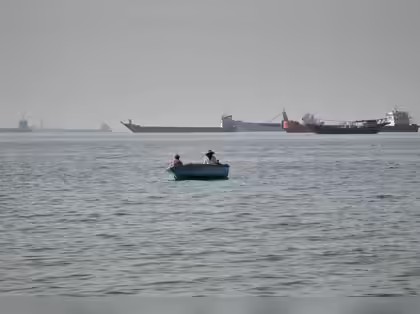
Iran and the United States have given conflicting accounts of an incident involving an oil tanker in the Strait of Hormuz, with Tehran saying the vessel exploded after hitting a sea mine while Washington blamed previous Iranian attacks.
Iran’s Islamic Revolutionary Guard Corps said the tanker, El Gaia, was sailing through the southern route of the strategic waterway when it struck a mine planted by Iranian forces.
Iranian state broadcaster IRIB reported that the vessel caught fire and was engulfed in flames after the explosion.
The United States Central Command, however, rejected the claim, saying the Panama-flagged tanker had already been targeted by Iran.
CENTCOM said El Gaia was struck by an Iranian missile last month and rendered inoperable. It added that the tanker was attacked again by an Iranian drone over the weekend while it was in waters off Oman.
The US military said the vessel is now being towed by a regional partner and accused the IRGC of making a false claim as part of efforts to intimidate commercial shipping and restrict movement through the strait.
The IRGC naval command has maintained that the Strait of Hormuz is closed and remains under Iranian control. Iran has reportedly warned vessels against using the southern passage, which it says has been mined, while designating a northern route along its coast as safe.
The dispute comes as the Strait of Hormuz remains a major flashpoint in the ongoing Iran-US conflict. Before the war, about one-fifth of the world’s oil supply passed through the waterway. Gulf countries also rely on the route to transport liquefied natural gas and fertiliser to international markets.
A planned meeting of Gulf foreign ministers on Monday to discuss the situation around the strait was cancelled at short notice.
Tensions have also increased in Yemen, where Iran-aligned Houthi fighters claimed to have launched missiles and drones at a military airbase in southern Saudi Arabia.
The Houthis said the attack on Khamis Mushait targeted aircraft hangars, radar systems, runways and ammunition depots. Saudi authorities subsequently issued emergency alerts in the area and three other southern cities.
The attack followed another strike on Saudi Arabia on Friday, which Riyadh attributed to Iran-backed fighters in Iraq. The incident reportedly disrupted the country’s east-west oil pipeline, which provides an alternative route for Gulf crude exports when shipping through the Strait of Hormuz is restricted.
The Houthis have also made territorial gains in Yemen in recent days, including the capture of Perim Island at the entrance to the Red Sea and the historic port of Mocha.
The escalation has heightened concerns over the security of major oil shipping routes and the potential disruption of global energy supplies.
The International Organisation for Migration estimates that about 82,000 Yemenis have fled their homes since the beginning of the month as fighting intensified.
Meanwhile, Washington has reportedly resisted Saudi requests for direct military intervention against the Houthis, limiting its support so far to intelligence assistance. Saudi Crown Prince Mohammed bin Salman met US regional commander Admiral Brad Cooper in Jeddah on Monday, according to Saudi state media.