Nigeria plans to push for an increase in its oil production quota at the upcoming OPEC meeting in November, according to the Minister of State for Petroleum Resources (Oil), Heineken Lokpobiri.
Speaking in Abuja during a review of the upstream sector’s performance since the Petroleum Industry Act (PIA) was enacted, Lokpobiri said the current quota of 1.5 million barrels per day no longer reflects Nigeria’s real capacity.
He explained that with output now averaging between 1.7 and 1.8 million barrels per day—including condensates—the country is in a strong position to request an upward review to about two million barrels daily.
“We have proven capacity to produce more than two million barrels per day, and the time is right to have our quota reviewed,” he said.
The minister attributed the rise in production to improved security, better pipeline monitoring, and the return of investor confidence in the oil sector. He noted that the number of active drilling rigs in Nigeria has climbed from around 14 to nearly 50, reflecting renewed exploration and production activity.
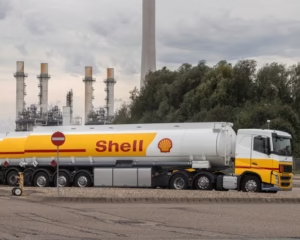
Lokpobiri also highlighted the growing contribution of local producers following divestments by major international oil companies like Shell, TotalEnergies, and ExxonMobil. Indigenous firms such as Renaissance and Seplat, he said, have significantly increased production after acquiring these assets.
He praised the Nigerian Upstream Petroleum Regulatory Commission (NUPRC) for implementing the PIA effectively and restoring investor trust, describing the commission as a model for energy regulation across Africa.
Lokpobiri further stated that the Federal Government’s policy measures and executive orders have begun to reduce Nigeria’s high cost of oil production, bringing it closer to the global average.
He expressed confidence that Nigeria’s goal of reaching 2.06 million barrels per day by 2025 is within reach, supported by stable operations, rising investments, and stronger local participation.
On the global stage, the minister stressed that Africa must define its own approach to energy transition, noting that the continent’s contribution to global emissions is minimal.
“Africa cannot industrialize without reliable energy,” he said. “We must use our own resources to fund our development before thinking about transition.”
Nigeria’s call for a higher OPEC quota is expected to be one of the main issues discussed at the November meeting, as the country pushes to align its production target with its expanding capacity.