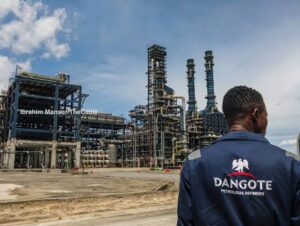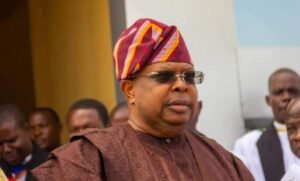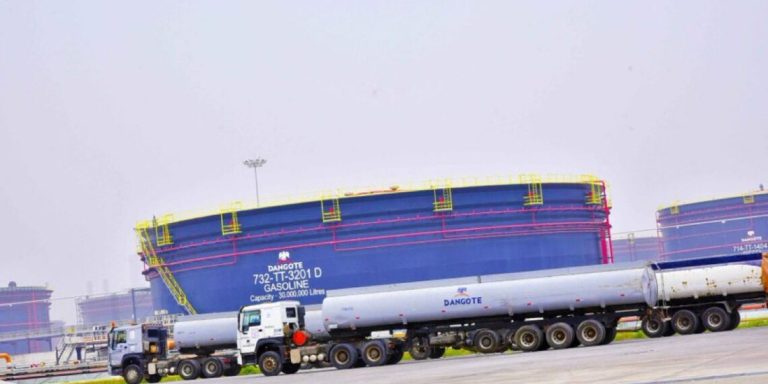
The President of the Dangote Group, Aliko Dangote, has confirmed that requests by Nigerian National Petroleum Company Limited to increase its ownership in the Dangote Petroleum Refinery were turned down, as the company prepares to open the project to a broader pool of Nigerian investors through a future public listing.
Speaking in an interview with Nicolai Tangen of the Norges Bank Investment Management, Dangote said the decision was deliberate. Rather than allow the state oil firm to expand its shareholding, the group wants more citizens and institutions to participate when shares of the refinery are eventually offered to the public.
NNPC bought 7.25 percent of the refinery in 2021 for $1 billion, with an option to raise its stake to 20 percent. That plan did not materialise. Dangote had earlier revealed that the national oil company stopped at the portion it paid for, leaving its ownership far below the widely assumed 20 percent.
According to him, policy uncertainty remains one of the biggest risks to the refinery’s long-term stability, alongside broader national challenges. He noted that limiting further concentration of ownership is part of a strategy to protect the project and deepen public participation.
Dangote disclosed that the plant has now processed as much as 661,000 barrels of crude per day, surpassing its 650,000 bpd design capacity. He said this operational milestone has strengthened confidence among lenders and partners who backed the multibillion-dollar project.
He listed support from institutions such as the African Export-Import Bank, Africa Finance Corporation, Zenith Bank, Access Bank, United Bank for Africa, Standard Bank, and Standard Chartered as critical to completing the refinery, especially after currency depreciation raised project costs.
Dangote said recent geopolitical tensions in the Middle East have lifted global energy and petrochemical prices, creating unexpected gains for the refinery and its fertiliser and plastics operations. He noted sharp increases in urea and polypropylene prices, adding that local plastic manufacturers would have struggled to source raw materials without domestic production. Jet fuel output from the refinery, he added, is already committed weeks ahead due to strong demand.
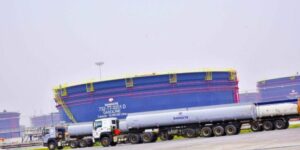
On feedstock, Dangote said more than half of the refinery’s crude now comes from Nigeria, with additional supplies from Angola, Libya and the United States. The facility currently takes in about 21 cargoes monthly. He also revealed plans to scale capacity to about 1.4 million barrels per day within the next 30 months, effectively more than doubling current throughput.
Dangote outlined a plan to bring in new investors and raise about $45 billion across group businesses to target $100 billion in annual revenue by 2030. He projected a significant rise in earnings before interest, taxes, depreciation and amortisation over the same period, alongside an ambitious market valuation goal.
Reflecting on his decision to focus on the refinery, Dangote said he sold his homes in the United States and the United Kingdom to base himself fully in Nigeria and concentrate on execution. He described his investment approach as centred on producing locally what the country previously relied on imports for.
The refinery, commissioned in 2023, is widely seen as central to Nigeria’s drive to cut fuel imports, stabilise supply and deepen local industrial capacity.