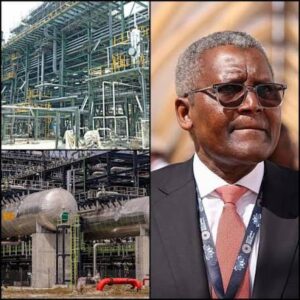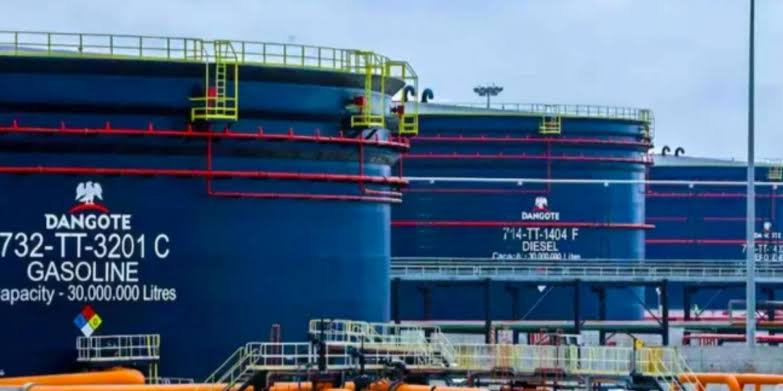
The President of the Dangote Group, Aliko Dangote, says his company declined fresh efforts by the Nigerian National Petroleum Company Limited to raise its ownership in the Dangote Petroleum Refinery above the current 7.25 per cent.
Dangote disclosed this during a recent interview with Nicolai Tangen, explaining that the refinery’s owners prefer to open future equity to a wider group of Nigerians and international investors when the company goes public.
He recalled that NNPC initially agreed to take up to 20 per cent equity in the refinery but paid for only a portion of the stake. After an extension to complete the payment expired in June 2024, the national oil firm opted to retain the 7.25 per cent it had already paid for.
Dangote said the group’s strategy now is to broaden participation rather than allow a single institution to increase its shareholding. He added that investors in the group’s businesses would earn dividends in dollars because a large share of revenue comes from exports.
Figures from the Nigerian Midstream and Downstream Petroleum Regulatory Authority indicate that local refinery petrol supply rose to 3.18 billion litres in the first quarter of 2026, while imports dropped to 965.52 million litres. Industry data show the Lekki refinery is currently the only facility producing petrol at commercial scale, meaning most of the local supply came from the plant.
With an average ex-depot price of about ₦1,000 per litre between January and March, the refinery’s domestic petrol supply is estimated at more than ₦3.2 trillion within the period.
Compared to the same quarter in 2025, local refining increased sharply while importation fell by over 60 per cent, reflecting a shift in Nigeria’s petrol supply structure. However, total supply in the first quarter of 2026 was slightly lower than in the corresponding period of 2025.
Dangote also revealed that the refinery recently processed crude at 661,000 barrels per day, exceeding its 650,000 bpd nameplate capacity. He said the plant now sources over half of its crude from Nigeria, with additional supplies from Angola, Libya and the United States, requiring about 21 cargoes monthly.
He projected that the refinery’s capacity could rise to 1.4 million barrels per day within the next 30 months.
Dangote noted that rising global energy prices linked to tensions in the Middle East have boosted export earnings for refined products, fertiliser and petrochemicals. He said the refinery produces about 20 million litres of jet fuel daily, much of which is already sold ahead.
Energy economist Wumi Iledare cautioned that while petrol import dependence has reduced significantly, it has not been completely eliminated, stressing that some level of importation is still needed to stabilise the market.
The disclosures and regulator data highlight a growing role for domestic refining in Nigeria’s fuel supply, with the Dangote refinery now at the centre of the country’s downstream petroleum market.