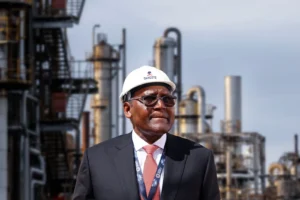
Aliko Dangote’s Dangote Industries Limited has entered into a major long-term agreement with China’s GCL Group to support a large-scale fertilizer project in Ethiopia.
The deal, valued at $4.2 billion, will see GCL supply natural gas over a 25-year period to power Dangote’s planned urea fertilizer plant in the country. The agreement was formalised in Lagos and represents a significant collaboration between African and Chinese industrial players.
The gas will fuel a new fertilizer complex expected to produce about three million tonnes of urea annually. The facility, estimated to cost $2.5 billion, is being developed in partnership with Ethiopian Investment Holdings under a 60:40 ownership structure. Operations are projected to begin in 2029.
Once completed, the plant is set to become the largest of its kind in East Africa. It is expected to meet Ethiopia’s domestic fertilizer demand and also supply neighbouring markets, helping to reduce reliance on imports and improve agricultural productivity across the region.
Gas for the project will be sourced from the Calub field in Ethiopia’s Ogaden Basin and transported through a dedicated pipeline to the plant site in the Somali Region. The development is part of broader efforts to link energy resources directly to agricultural and industrial output within Africa.
Speaking on the partnership, Dangote emphasised the need for Africa to move beyond exporting raw materials and instead focus on building integrated industries that add value locally. He noted that the project will create a full value chain, from gas extraction to fertilizer production, aimed at strengthening food security.
Chairman of GCL Group, Zhu Gongshan, said the collaboration reflects a shift toward deeper, mutually beneficial partnerships between China and Africa. He added that the project would enhance both companies’ presence in Ethiopia’s energy and industrial sectors.
Analysts say the initiative could drive economic growth in Ethiopia by creating jobs, boosting infrastructure development, and unlocking industrial potential in the Somali Region. It is also seen as aligning with global trends toward cleaner industrial processes, as natural gas is considered a lower-carbon alternative for fertilizer production.
The project highlights increasing cooperation between China and Africa in strategic sectors, with a focus on long-term industrial development, energy independence, and food security.