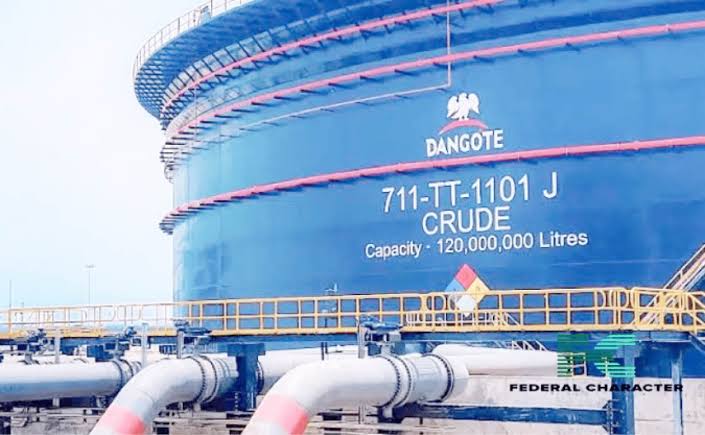
Independent petroleum marketers and industry experts have criticised Dangote Petroleum Refinery’s decision to price petroleum products in United States dollars, warning that the move could increase pressure on Nigeria’s foreign exchange market and push up fuel prices.
The refinery recently informed customers that all previously issued payment documents in naira for gantry and coastal fuel purchases had been cancelled as it officially switched to dollar-denominated transactions for Premium Motor Spirit (petrol), Automotive Gas Oil (diesel), and aviation fuel.
The announcement immediately triggered price adjustments across several private depots, with petrol and diesel loading costs rising in Lagos, Port Harcourt and Warri as operators revised prices to reflect higher replacement costs.
Reacting to the development, the Petroleum Products Retail Outlets Owners Association of Nigeria said the policy could encourage the gradual dollarisation of the economy and undermine efforts to stabilise the downstream petroleum sector.
The association’s National President, Billy Gillis-Harry, argued that although Dangote Refinery is a private business with the freedom to make commercial decisions, its actions could have far-reaching consequences because of its significant influence on the local fuel market.
He warned that marketers buying products in dollars would eventually transfer the additional costs to consumers, while also expressing concern that operators would now have to compete for scarce foreign exchange to purchase petroleum products.
Gillis-Harry maintained that competition remains the best way to moderate fuel prices, urging the Nigerian National Petroleum Company Limited to restore the country’s refineries to full operation and reduce reliance on a single dominant supplier.
The Independent Petroleum Marketers Association of Nigeria also called on President Bola Tinubu to intervene by sustaining the crude-for-naira arrangement introduced to support local refining.
According to the association’s National Publicity Secretary, Chinedu Ukadike, fuel prices are already influenced by global crude oil prices and exchange rate movements, and additional demand for dollars by marketers could further increase pump prices.
He noted that greater pressure on the foreign exchange market would ultimately be reflected in higher fuel costs for consumers, especially as several aspects of petroleum trading and logistics are already settled in dollars.
Energy experts, however, expressed differing opinions on the refinery’s decision.
Petroleum economist and Professor Emeritus Wumi Iledare described the policy as a commercial strategy aimed at reducing foreign exchange exposure rather than an attempt to dictate market prices.
He explained that in a deregulated market, refiners are free to announce their selling prices, while buyers ultimately determine whether those prices become market benchmarks through competition and available alternatives.
Iledare added that because crude oil, refinery equipment, spare parts and financing are largely linked to international markets, aligning revenues with dollar-based obligations is a common risk management approach.
He nevertheless stressed that regulators should continue to ensure adequate competition, transparency and consumer protection within the downstream sector.
Offering a different perspective, University of Lagos energy professor Dayo Ayoade argued that petroleum products sold within Nigeria should ordinarily be priced in naira, which remains the country’s legal tender.
While acknowledging that Dangote Refinery may be seeking protection against exchange rate losses, Ayoade questioned whether domestic fuel sales should be denominated in a foreign currency, particularly considering the financial support the refinery received locally during its development.
He urged regulatory agencies, including the Nigerian Midstream and Downstream Petroleum Regulatory Authority, the Federal Competition and Consumer Protection Commission and the Central Bank of Nigeria, to examine the legal and economic implications of the policy.
The Chief Executive Officer of Petroleumprice.ng, Jeremiah Olatide, also called on the Federal Government to review the development, warning that expanding dollar-denominated transactions in the domestic petroleum market could place additional financial burdens on Nigerians.
The latest development has reopened debate over the balance between market deregulation, private sector investment, foreign exchange realities and consumer protection, as Dangote Refinery continues to play a dominant role in Nigeria’s fuel supply chain.