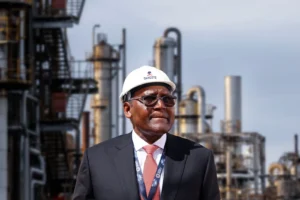
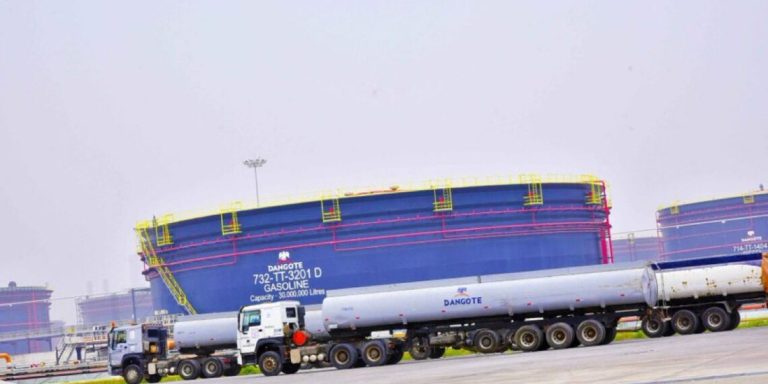
The recent conflict between the United States and Iran has strengthened the market position of the Dangote Petroleum Refinery, with increased international demand for its refined fuel products contributing to higher revenues and a rise in the wealth of the company’s founder, Aliko Dangote.
According to a report by The Wall Street Journal, the 650,000-barrel-per-day refinery has benefited from heightened demand for diesel, jet fuel and petrol following disruptions to energy markets linked to tensions in the Middle East. The facility, which reached full operational capacity earlier this year, has become an alternative source of refined products that do not rely on shipping through the Strait of Hormuz.
The report said Dangote’s net worth has increased by about $4.86 billion since the beginning of the year, placing his fortune at approximately $34.8 billion, based on the Bloomberg Billionaires Index.
Production at the refinery has reportedly expanded significantly this year as exports to regional and international markets continue to grow. Demand has risen across sub-Saharan Africa, while shipments of jet fuel to Europe have also increased.
Dangote Industries Group Vice-President, Devakumar Edwin, said the company intends to list the refinery on the Nigerian Exchange before the end of the year, with a target valuation of at least $50 billion. He added that the firm is also considering a secondary listing, likely in New York.
The company is also pursuing an ambitious expansion strategy. Plans are underway to increase the refinery’s processing capacity to about 1.4 million barrels per day by 2028 through an investment estimated at $13 billion.
Beyond Nigeria, Dangote Industries is reportedly developing another large refinery project in Lamu, Kenya, alongside a new seaport. The proposed investment is expected to cost around $15 billion and could be completed within three years.
Despite the refinery’s growing success, access to sufficient domestic crude oil remains a key challenge. The report noted that the Nigerian National Petroleum Company Limited has struggled to meet the refinery’s supply requirements because of existing export commitments and oil-backed financing arrangements.
To strengthen its distribution network, the company also plans to acquire additional vessels, establish a regional distribution hub in Namibia and build a pipeline network to deliver refined petroleum products to landlocked African countries, including Zimbabwe, Botswana and Zambia.