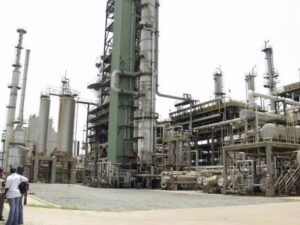
The Crude Oil Refinery Owners Association of Nigeria has urged the Federal Government to take urgent steps to reduce petroleum product imports and strengthen domestic refining.
The association made the call in a position paper issued on Thursday, saying local refinery operators were struggling with foreign exchange pressures, high borrowing costs, limited access to long-term financing, crude supply challenges, inadequate infrastructure and rising logistics expenses.
CORAN said Nigeria’s dependence on imported fuel could undermine investments in local refineries and place additional pressure on foreign exchange.
The association also expressed concern over the difficulty domestic refineries face in obtaining crude oil at commercially viable prices.
It reported that 61.9 million barrels were allocated to local refineries in the first quarter of 2026, while producers offered 68.7 million barrels. However, only 28.5 million barrels were delivered during the period.
CORAN attributed the gap partly to pricing differences between crude producers and domestic refiners.
The situation improved in the second quarter, when 53.7 million barrels of crude oil and condensate were supplied to local refineries, representing 97.4 per cent performance under the Domestic Crude Supply Obligation.
However, the association said crude allocation alone was not enough, stressing that refineries needed reliable supplies at commercially sustainable prices.
CORAN proposed a domestic crude pricing framework that would consider international crude benchmarks, oil quality, delivery locations, transportation and logistics costs, freight savings and the distance between producing fields and refineries.
The association also called for tighter control of petroleum product imports, saying imports should mainly be used to cover verified supply shortages.
It cited data from the Nigerian Midstream and Downstream Petroleum Regulatory Authority showing that domestic petrol supply declined from about 32.5 million litres per day in June to 25.8 million litres per day in July 2026. Over the same period, petrol imports increased from approximately 18.1 million litres to 19.7 million litres per day.
CORAN warned that allowing imports to continue alongside increasing domestic refining capacity could discourage investment in the sector, increase foreign exchange demand and expose the country to international supply disruptions.
The association identified access to finance as another major challenge and urged the government to establish a financing framework for refinery development and expansion.
It also proposed the development of large, medium-sized and modular refineries near crude-producing areas and major centres of fuel demand.
Among its recommendations, CORAN called for wider use of naira-for-crude transactions, stronger enforcement of the Domestic Crude Supply Obligation, greater use of crude swaps, gradual reduction of fuel imports, shared petroleum infrastructure and strategic product reserves.
The association said government support should focus more on increasing domestic production rather than subsidising consumption.
It maintained that strengthening refineries, pipelines, storage facilities, crude supply and long-term financing would help Nigeria build a competitive refining industry and eventually become a major petroleum products hub in Africa.