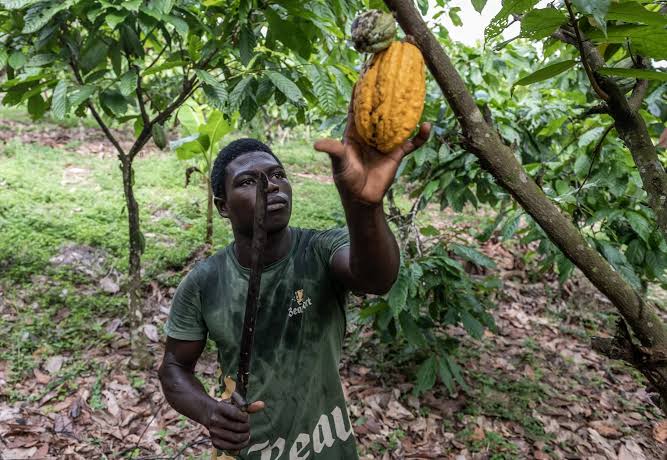
Nigeria is turning back to agriculture to revive its struggling cocoa industry amid a sharp rise in global cocoa prices and a decline in crude oil revenues. Once a significant cocoa producer, Nigeria now trails behind Ivory Coast and Ghana, producing just 485,000 tonnes in 2006 compared to 1.67 million and 530,000 tonnes, respectively.
Adeola Adegoke, head of the Cocoa Association of Nigeria (CFAN), emphasized the country’s potential: “Nigeria can do better than its neighbours if it focuses on agriculture rather than oil.” The government recently approved a bill to establish a national cocoa authority, aiming to replicate the success of Côte d’Ivoire and Ghana by improving infrastructure, credit access, and price stability.
However, the sector faces serious obstacles. “Farmers are fleeing their lands and contracts are being violated,” Adegoke said, pointing to banditry, farmer-herder conflicts, and poor infrastructure. Additionally, much of Nigeria’s cocoa—87-90%—is exported raw, limiting local processing.
Olasunkanmi Owoyemi of Sunbeth Global Concepts highlighted the potential for growth: “The Nigerian cocoa industry is still alive and well and can do better. We have a lot of farmland and a large population, but we need trained and empowered people with the right resources.”
With oil accounting for 90% of Nigeria’s exports, the country stands at a crossroads: diversify through agriculture or risk losing ground in the global market.
For agri market insights, UkrAgroConsult offers its multi-functional AgriSupp platform, providing daily data and analytics on Black Sea and Danube grain and oilseed markets. A 7-day free demo access is available for interested users.