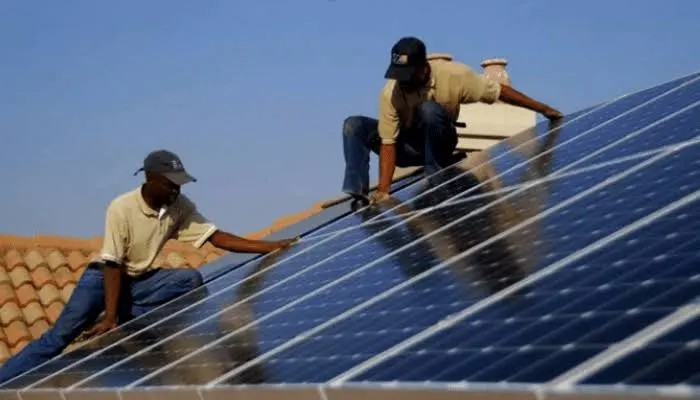
Energy policy experts are warning that Nigeria’s proposed ban on solar panel imports could backfire, driving up costs, stalling renewable energy adoption, and deepening energy poverty across the country.
The controversial plan, led by Minister of Science and Technology Uche Nnaji, is aimed at boosting local manufacturing and reducing reliance on foreign solar products. But critics argue the policy lacks the necessary groundwork and will derail the country’s clean energy goals.
“This ban will stifle Nigeria’s growing off-grid solar sector, which has already added over 1,000 megawatts to our power mix,” said Basil Abia, a policy analyst and co-founder of Veriv Africa. “Without a strong domestic supply chain, we’ll see costs skyrocket and progress reversed.”
Currently, solar energy contributes less than 0.5% to Nigeria’s national grid, which itself delivers a limited 5,700 MW daily. Meanwhile, Nigerians independently generate over 45,000 MW through diesel and petrol generators, according to data from Stears.
“Nigeria lacks the infrastructure to produce solar panels at scale. No polysilicon production, no efficient supply chain, and no verified local manufacturers. What we have is talk, not capacity,” Abia stressed.
He added that projects like NASENI’s $172 million plant in Nasarawa remain “largely non-operational,” while locally made panels are “virtually nonexistent” in major urban markets.
Abia urged the government to rethink its approach and act more as a market enabler than a regulator. “The government should be building supply chains, offering tax incentives, and supporting R&D — not reaching for a blunt instrument like a ban,” he said.
He warned that an import ban could create monopolies. “History shows that protectionist policies breed cartels, not competition. A solar cartel could emerge, pricing millions out of access and repeating the mistakes of the petrol sector,” he cautioned.
Instead, experts are calling for targeted incentives to attract investors and support local solar firms, including tax breaks, low-interest loans, and subsidies for innovation. “China didn’t ban first — they built the capacity. Why is Nigeria trying to flip that logic?” Abia questioned.
The proposed ban also threatens Nigeria’s commitment to its Energy Transition Plan, which targets 60% clean energy by 2050.
“The energy transition is not a slogan — it’s a developmental necessity. What we need is a smarter approach grounded in data, coordination, and investment, not reactionary bans,” Abia concluded.