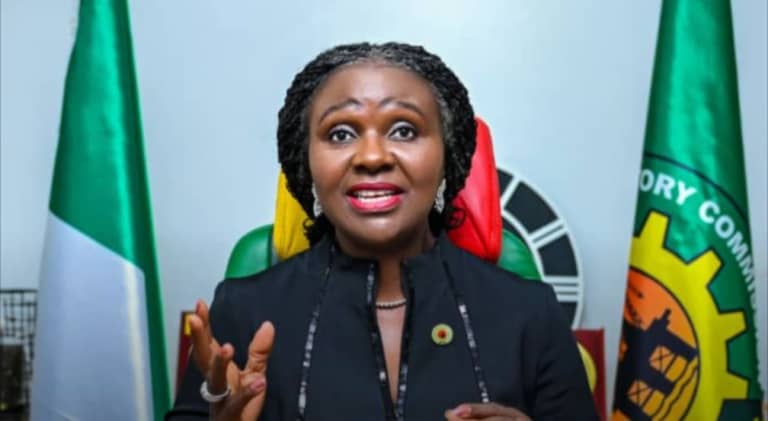
The Chief Executive of the Nigerian Upstream Petroleum Regulatory Commission (NUPRC), Mrs. Oritsemeyiwa Eyesan, has called on African countries to deepen cooperation and align regulations to unlock the continent’s vast energy and mineral wealth.
Speaking at the Nigeria International Energy Summit (NIES) 2026 in Abuja, Eyesan said Africa’s future growth depends largely on its ability to act collectively rather than pursue fragmented national approaches to energy development.
She noted that Africa holds close to 30 per cent of the world’s known critical minerals, including more than half of global cobalt reserves, as well as large deposits of manganese, graphite and platinum group metals.
According to her, these resources, combined with Africa’s youthful and fast-growing population of over 1.5 billion people, give the continent a strong foundation for industrial expansion if supported by coordinated policies and shared infrastructure.
Eyesan stressed that oil and gas continue to play a vital role in Africa’s development, supporting electricity supply, clean cooking initiatives, fertiliser and petrochemical production, and providing revenues used for infrastructure and social services.
She warned that without unity, Africa risks failing to convert its natural advantages into tangible benefits for its people. “Our resources can either remain scattered across borders or become the backbone of a new era of shared prosperity. Unity will determine the outcome,” she said.
Highlighting the urgency of collaboration, Eyesan referenced international data showing that more than 600 million Africans still lack access to electricity, while nearly one billion depend on traditional cooking fuels, despite Africa contributing only a small share of global greenhouse gas emissions.
She said Africa’s collective stance has already proven effective globally, citing the creation of the loss and damage fund at COP27, which was achieved through coordinated advocacy by African nations. According to her, the same approach is needed to secure a fair energy transition that acknowledges Africa’s development priorities and the role of natural gas as a transition fuel.
Eyesan also pointed to successful regional projects as evidence that cooperation works. These include the CLSG power transmission line connecting Côte d’Ivoire, Liberia, Sierra Leone and Guinea, which supplies electricity to millions of people, as well as the West African Gas Pipeline that transports Nigerian gas to neighbouring countries.
However, she said years of poor coordination have left much of Africa’s gas potential untapped. Over 180 trillion cubic feet of discovered gas across the continent remains undeveloped, while Nigeria alone holds about 210 trillion cubic feet of proven reserves, with significant additional potential.
“For a long time, gas was found in one country, demand existed in another, and industries were located elsewhere, with no pipelines or aligned tariffs to connect them,” she explained, adding that projects such as the Nigeria–Morocco Gas Pipeline and the Trans-Saharan Gas Pipeline are now helping to bridge these gaps.
She further said harmonised regulations would make it easier for African financial institutions, including the African Energy Bank and the African Development Bank, to support projects, reduce investment risks and attract private capital.
According to Eyesan, Nigeria is already taking steps to lead in regulatory alignment through transparent licensing rounds and reforms designed to create a competitive and investor-friendly environment. She disclosed that African regulators have also set up the African Petroleum Regulators Forum (AfriPET) to promote shared standards, data exchange and capacity building across the continent.
She concluded by reaffirming Africa’s commitment to speaking with one voice on global platforms, strengthening regional energy networks and adopting common sustainability standards.
“One Africa, one regulatory voice, one energy future,” she said, adding that unity remains the key to delivering Africa’s energy promise.