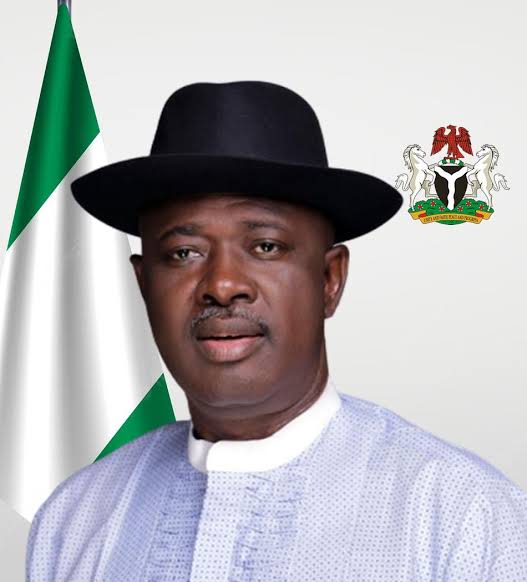
Nigeria’s Minister of State for Petroleum Resources (Oil), Senator Heineken Lokpobiri, has issued a stern warning to oil companies: deliver results or risk losing your licenses. Speaking at the Nigeria Oil and Gas (NOG) Week in Abuja, he made it clear that the federal government is no longer tolerating underperformance, especially after offering multiple incentives aimed at reviving the sector.
Lokpobiri argued that the Bola Tinubu administration has done its part by improving the business environment — through reforms, fiscal incentives, and regulatory streamlining but production levels remain disappointingly low. He accused some operators of hoarding licenses and failing to make meaningful contributions to national output, saying, “We’re not just looking for promises anymore we want performance.”
He emphasized that upstream oil assets must deliver value or be reassigned, as the government prepares to review all partnership agreements in line with national economic goals. The minister added that the era of dormant fields and idle licenses is over and challenged operators to either develop their assets or step aside.
The federal government, he noted, is pushing forward with efforts to unlock dormant wells, revive shut-in fields, and drive investment in the sector, especially as global funding for fossil fuels becomes more competitive.
Speaking on financing, NNPC Group CEO Bayo Ojulari provided a more optimistic outlook. He announced that the national oil company now has the capacity to independently raise funds for all its projects a significant milestone made possible by the Petroleum Industry Act (PIA). He described this as a “turning point” for the company, which has struggled in the past with cash call obligations.
Ojulari also pointed out that Nigeria’s oil production is still lagging — despite 100% availability of pipelines. In June, crude production stood at just 1.35 million barrels per day, increasing to 1.6 million barrels when condensates are included. “If infrastructure is available, then the bottleneck is investment,” he said, revealing that underinvestment has plagued the industry for over a decade.
Still, he offered a hopeful outlook: the industry secured $17 billion in new investments in 2024, and plans are underway to hit $30 billion by 2027 and $60 billion by 2033.
Meanwhile, the Minister of State for Petroleum Resources (Gas), Ekperikpe Ekpo, reaffirmed Nigeria’s commitment to using gas as a cleaner transition fuel. With over 200 trillion cubic feet of proven reserves, Ekpo highlighted gas as key to Nigeria’s economic transformation, especially through power generation and industrial applications.
He also cited progress on several fronts: from the Midstream and Downstream Gas Infrastructure Fund (MDGIF) to regional pipeline projects such as the West African Gas Pipeline, aimed at strengthening regional energy cooperation.
OPEC Secretary General Haitham Al Ghais, speaking virtually at the event, predicted that global energy demand would rise 23% by 2050, largely driven by population growth and rapid urbanisation in non-OECD countries. He underlined the urgent need for investment and infrastructure to meet this growing demand, particularly in developing nations.
As Nigeria positions itself for greater energy leadership, Lokpobiri left oil companies with a final challenge: “Step up, or step aside.”