The Nigerian Midstream and Downstream Petroleum Regulatory Authority says the Dangote Petroleum Refinery & Petrochemicals shipped about 434 million litres of Premium Motor Spirit (petrol) out of Nigeria in March 2026 after producing far more than the local market required.
Figures from the regulator’s March downstream fact sheet show the refinery turned out roughly 1.49 billion litres of petrol during the 31-day period. Of that volume, around 1.06 billion litres was distributed within Nigeria, leaving a sizeable balance for export.
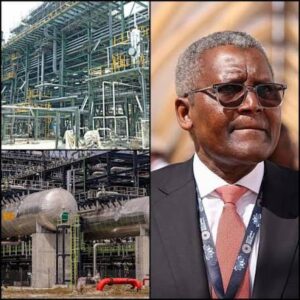
The plant, owned by Aliko Dangote, reportedly operated at an average utilisation rate of 93.62 per cent for the month, underscoring its growing dominance in the country’s fuel supply chain.
Daily output averaged about 48.2 million litres, while approximately 34.2 million litres per day went into the domestic market. The difference translated into hundreds of millions of litres sold beyond Nigeria’s borders, highlighting the refinery’s expanding footprint across regional markets.
The development marks a significant shift for a country that for decades relied on imported petrol to meet local needs. In a statement earlier this week, the refinery cited market intelligence data indicating that petrol imports into Nigeria fell sharply in March to about 41,000 barrels per day, the lowest level recorded so far.
At the same time, crude deliveries to the facility climbed to roughly 565,000 barrels per day, one of the highest intake levels since the 650,000 barrels-per-day plant began operations in late 2023. Gasoline exports from the refinery rose to around 44,000 barrels per day during the month, enabling Nigeria to post a modest net export position.
Part of the export cargo reached East Africa for the first time, with a shipment of 317,000 barrels sent to Mozambique. Another consignment is scheduled for the same destination in April, signalling new trade routes for Nigerian refined products.
The regulator’s data also points to strong diesel production. The refinery reportedly produced about 16.5 million litres of Automotive Gas Oil daily but supplied only a fraction of that volume locally, implying that much of it was also exported.
While the Dangote facility ramped up output, Nigeria’s state-owned refineries remained largely idle. The Port Harcourt Refining Company was shut, though small volumes of previously produced diesel were evacuated. The Warri Refining and Petrochemical Company and the Kaduna Refining and Petrochemical Company did not operate during the period.
By comparison, three modular refineries; Walter Smith Refinery, Edo Refinery and Petrochemical Company, and Aradel Refinery jointly supplied less than one million litres of diesel per day.
Industry observers say the steady rise in output from the Lekki-based refinery is gradually reversing Nigeria’s long-standing dependence on imported fuels, improving local availability and opening up export opportunities. However, they note that consistent crude supply, efficient distribution networks, and the revival of government-owned refineries will be necessary to fully realise the benefits of the country’s expanding refining capacity.