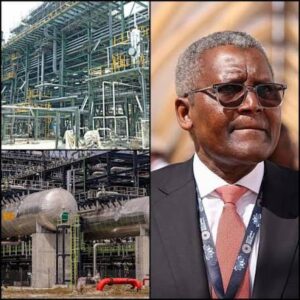
The Dangote Petroleum Refinery in Lagos is currently undergoing upgrades to raise its production capacity from 650,000 barrels per day (bpd) to 700,000 bpd. The enhancement project is expected to be completed by the final quarter of 2025.
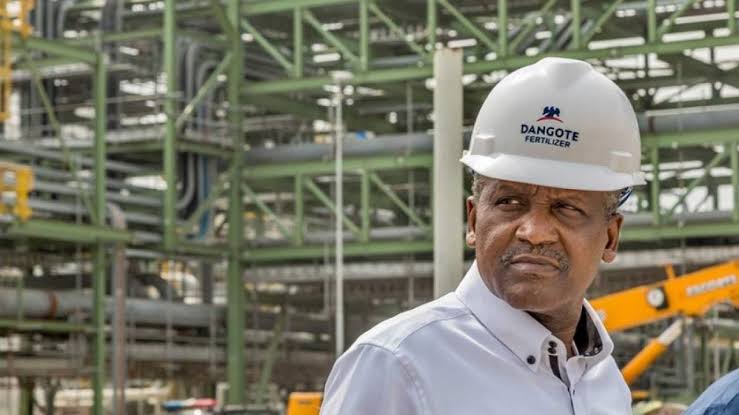
Aliko Dangote, President of the Dangote Group, shared this during a recent facility tour, noting that the refinery is being modified to improve performance across key units. He mentioned that the Residue Fluid Catalytic Cracking (RFCC) unit, which helps convert heavy crude into valuable products like petrol and diesel, is already running at 85% capacity.
Dangote expressed optimism that the refinery would soon surpass its original design, pointing out that some units are operating well beyond their targets — even exceeding 100%.
He also revealed that between June and July 2025, the refinery secured around 19 million barrels of crude oil from the United States, with U.S. imports making up more than half of the refinery’s crude supply in July alone.
Reflecting on the refinery’s journey, Dangote said he had originally aimed to acquire government-owned refineries, but that plan was halted in 2007 by former President Umar Musa Yar’Adua. Undeterred, he chose to build a private refinery instead, a decision he said came with far more challenges than expected.
“If I had known how difficult it would be, I might not have started,” he admitted. “But we kept pushing through, and now we’re seeing the results.”
He added that the refinery is critical for Africa, where most countries rely heavily on imported fuel. Aside from Algeria and Libya, many nations across the continent do not have the capacity to meet their own energy needs.
Dangote also criticized foreign players who, he claimed, undermine African industries by flooding the market with imports. He cited the high number of fuel ships docked at ports like Lomé as part of this strategy, and noted that even South Africa has only one functional refinery at the moment.
With the ongoing expansion, the Dangote Refinery aims to strengthen Nigeria’s energy independence and reduce the continent’s reliance on imported petroleum products.