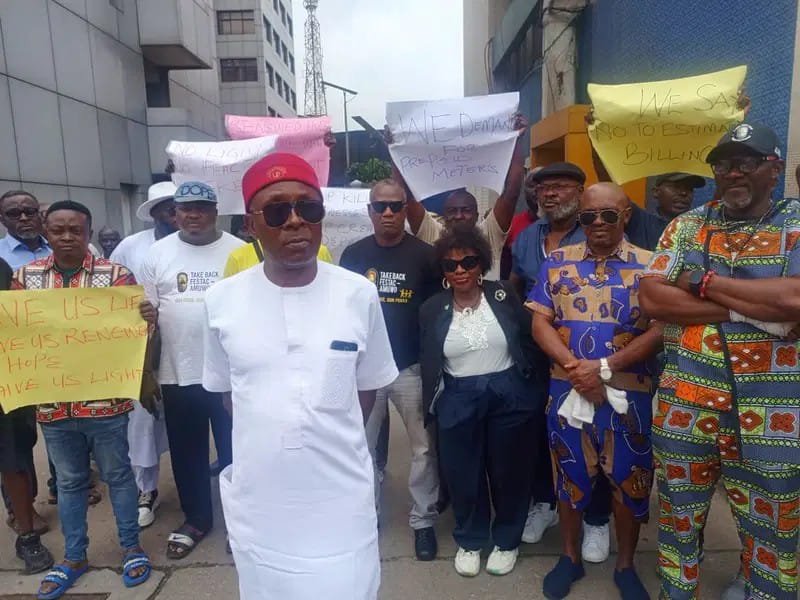
Residents of FESTAC Town have given the Eko Electricity Distribution Company a two-day deadline to restore power to the estate, warning of mass action if nothing changes. The group, operating under the name Take Back FESTAC, says the community has gone without steady electricity for more than eight months while still being hit with estimated bills.
On Tuesday, protesters marched to EKEDC’s head office in Marina, Lagos, to deliver the ultimatum in person. They said months of back-and-forth with the company had gone nowhere, despite earlier promises that a transmission upgrade would fix the problem.
Convener Valentine Uduebor told reporters the protest wasn’t about him but about a community pushed past its limit. He described switching to solar power years ago just to survive, saying he’d barely touched a prepaid token he bought over a year back because there was simply no electricity to use it on. He questioned how EKEDC could keep running, paying staff and covering overheads, if customers weren’t actually consuming power. He also appealed directly to the presidency, saying bureaucratic bottlenecks seemed to be undoing whatever progress the government intended.
Uduebor said residents had given EKEDC the benefit of the doubt once already, after officials asked for five months to sort things out. That window came and went with no real change, he said, which is why the group escalated to a public deadline.
Group Vice President James Ibeka said the trip to Marina alone spoke volumes about how broken the situation had become, noting some stretches saw barely two hours of cumulative power over three months. He pointed to the ripple effects: rising living costs, spoiled food, shuttered businesses, and residents paying up to ₦10,000 a day on generator fuel just to keep basic life running.
Public Relations Officer Nathaniel Ussi pushed for faster rollout of prepaid meters, arguing that residents stuck on estimated billing were being charged for power they never received. He said many local businesses had already shut down entirely, unable to survive on generators alone.
A local doctor, Dumebi Owa, warned that the blackout has become a genuine threat to healthcare in the area, describing the danger of losing power mid-surgery or while patients depend on life support equipment. She accused EKEDC of leaning on estimated billing because it’s simply more profitable for them.
One resident, who gave his name only as Michael, said he gets maybe 30 minutes to an hour of electricity on a good day, yet still pays roughly ₦15,000 a month, with unpaid balances rolling over and compounding. His ask was simple: give residents prepaid meters so they only pay for what they actually use.
By the end of the protest, a small group of residents was invited inside for a private meeting with EKEDC management. The company did not respond to requests for comment from journalists on the ground.