Myanmar has completed a four-day training programme aimed at strengthening the country’s power sector and supporting the expansion of renewable energy.
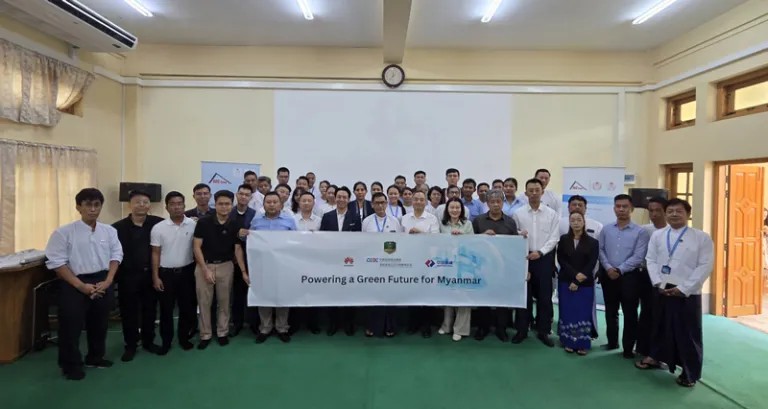
The programme, organized by the Ministry of Electricity and Energy (MOEE) in collaboration with Huawei Digital Power Myanmar, Power China Kunming Engineering Corporation Limited, and China Energy Engineering Group Hunan Institute, was held at the Nay Pyi Taw Training Centre.
About 50 officials from the Department of Electric Power and Planning (DEPP), Electric Power Generation Enterprise (EPGE), and the Department of Power Transmission and System Control (DPTSC) participated in the training, which focused on renewable energy integration, grid modernization, and power system development.
During the opening session, Deputy Director General U Zaw Win Naing outlined Myanmar’s plans to increase the share of renewable energy in the country’s power mix. He said the government aims to raise renewable energy generation to 11% and hydropower to 28%, bringing the combined share of renewable sources to 39% in the future.
Experts at the programme discussed advanced technologies that can improve grid stability and support greater use of renewable energy. Topics included battery energy storage systems, digital power solutions, and grid-forming technologies designed to strengthen electricity networks.
Huawei Digital Power Chief Scientist Dr. Liu Yunfeng presented developments in grid-forming technology and highlighted international renewable energy projects that combine solar power and energy storage to improve energy reliability.
Participants also received training on electricity tariff reforms and solar-plus-storage solutions that could help accelerate clean energy adoption while reducing electricity costs and improving grid performance.
The programme concluded with a certificate presentation ceremony and a visit to the Shwe Myo Solar Project, where participants gained practical insights into renewable energy operations.
The initiative is part of Myanmar’s efforts to modernize its electricity sector, improve energy security, and increase the use of renewable energy across the country.