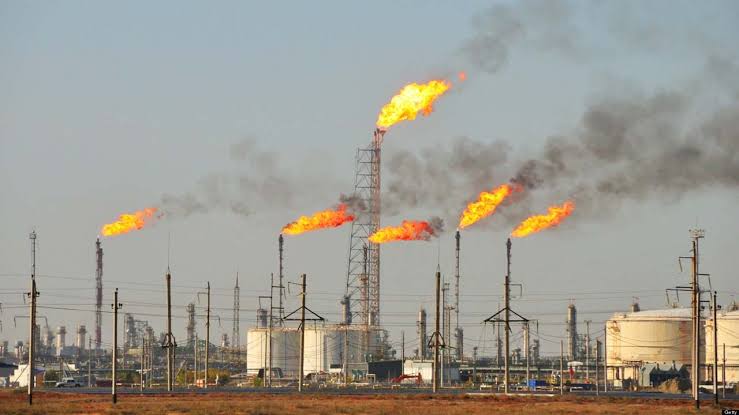
Nigeria flared more than 203.9 billion standard cubic feet (scf) of natural gas in 2025, even as the country maintained a high gas utilisation rate above 92%, according to the Nigerian Upstream Petroleum Regulatory Commission (NUPRC).
The latest NUPRC Gas Production Status Report shows that total gas output last year reached about 2.71 trillion scf, with Associated Gas contributing 1.46 trillion scf and Non-Associated Gas 1.25 trillion scf. Of this, roughly 2.5 trillion scf was used for domestic supply, field operations, and exports.
Despite this high utilisation, gas flaring increased compared to 2024, when 192.9 billion scf was flared. Monthly flaring ranged from 15 billion scf to 18 billion scf, peaking in January (18.7 billion scf) and July (18.3 billion scf). September saw the lowest gas utilisation at 90.9%, which coincided with the year’s highest flaring rate of 9.05%.
The report highlights that flaring is largely linked to Associated Gas, which is produced alongside crude oil. Unlike Non-Associated Gas, which has dedicated processing and transport infrastructure, Associated Gas is more susceptible to flaring during plant downtime or operational constraints.
While Non-Associated Gas output increased in 2025, its contribution to flaring remained relatively low due to better alignment with infrastructure and market demand. Meanwhile, challenges such as limited offtake capacity and transportation bottlenecks continued to force operators to flare gas during production disruptions.
In terms of consumption, about 776.6 billion scf of gas was used for field operations, 780.6 billion scf supplied the domestic market, and 942.7 billion scf was exported, mainly as liquefied natural gas (LNG).
Experts warn that flaring over 203 billion scf carries serious environmental and economic consequences. Gas flaring not only increases greenhouse gas emissions but also contributes to local air pollution and poses health risks in host communities.
While Nigeria has made some progress in reducing flaring, such as achieving a rate of 7.16% in July 2025, the country remains one of the world’s top gas-flaring nations, reflecting the persistent structural challenges in its oil and gas sector.