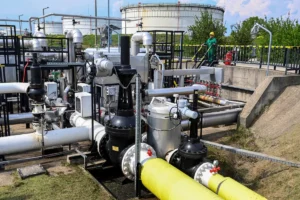

Nigeria has officially resumed local crude oil refining for the first time in 25 years—a move the government credits to President Bola Tinubu’s sweeping economic reforms.
Minister of Budget and Economic Planning, Atiku Bagudu, announced the milestone during a televised documentary marking Tinubu’s second anniversary in office.“For the first time in 25 years, Nigeria is refining oil,” Bagudu said.
“Mr President was courageous enough to allow crude sales in naira to our refiners.”The restart of domestic refining marks a turning point for a country that has long depended on imported fuel, despite being Africa’s largest oil producer.
Bagudu said the reforms—including scrapping fuel subsidies, unifying the forex market, and allowing naira-denominated crude sales—have begun to reshape the economy.“We were losing 5% of our GDP on fuel subsidies—money going to just a few,” he noted.
Despite persistent security challenges such as pipeline vandalism, Bagudu stated that Nigeria had surpassed its oil production target of 2.1 million barrels per day.
The goal, according to the administration, is to hit 2 million barrels by 2027 and 3 million by 2030.The Nigerian National Petroleum Company (NNPC) is expected to refine 200,000 barrels per day by 2027, with plans to scale up to 500,000 barrels by 2030.
To drive efficiency and transparency, Tinubu appointed former Shell executive Bayo Ojulari as NNPC’s managing director in April.
Bagudu also pointed to broader signs of progress, including stable foreign exchange, rising investor confidence, and four consecutive quarters of economic growth.
“Investors want credible, transparent policies,” he said. “It might feel painful now, but the muscles of progress are forming.”
The N54.99 trillion 2025 budget, he said, balances fiscal discipline with investments in social welfare, infrastructure, and security—key pillars of Tinubu’s “Renewed Hope Agenda.”“This is two years well spent,” Bagudu concluded, defending the administration’s approach as a long-term play for economic stability and self-reliance.