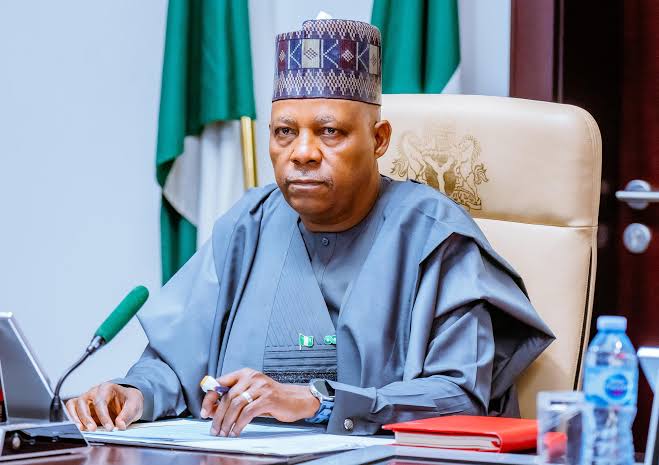
Vice President Kashim Shettima has emphasized the need for Nigeria to reduce its heavy dependence on the global oil market by turning to cleaner energy alternatives specifically, green hydrogen.
Speaking during the Nigeria 4H₂ Project Results Workshop in Abuja, Shettima said the country aims to attract $5 billion in private investment and generate $10 billion annually from green hydrogen exports by the year 2035. The initiative is expected to create 500,000 new jobs in sectors such as technology, logistics, manufacturing, and engineering.
The Nigeria 4H₂ project, supported by Germany, explores the potential of producing green hydrogen in Nigeria using renewable energy sources like solar and wind. The project also looks into converting hydrogen into green ammonia for fertiliser production.
Represented by his Special Adviser on Economic Affairs, Dr. Tope Fasua, Shettima said that despite Nigeria’s vast hydrocarbon resources, the global push toward clean energy requires a shift in focus. He described green hydrogen as a promising solution for diversifying Nigeria’s energy mix, reducing emissions, and driving economic growth.
Dr. Mustapha Abdullahi, Director General of the Energy Commission of Nigeria (ECN), noted that several countries are moving toward low-carbon energy, with hydrogen becoming a key part of their strategy. Represented by Ibrahim Sulu, he revealed that Nigeria has developed a national hydrogen policy and strategy to guide implementation.
The roadmap includes plans to scale up hydrogen exports through Lekki Port by 2035, attract billions in investment, cut carbon emissions by 20% in the industrial sector, and contribute significantly to GDP through clean energy exports.
Prof. Emmanuel Ramde, Executive Director of WASCAL, added that Nigeria continues to face challenges like limited electricity access, food insecurity, and fertiliser shortages. He said the project—developed in collaboration with Nigerian universities such as FUTA, FUT Minna, and Afe Babalola University—shows that Nigeria could produce over 4 million tonnes of green ammonia annually by 2060, meeting both local and international demand.
The overall goal is to position Nigeria as a major player in the emerging global green energy economy while addressing critical domestic development needs.