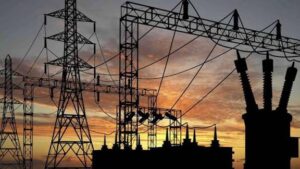
The Federal Government says it expects to earn nearly $1bn annually from electricity exports to 15 West African nations once permanent grid synchronisation begins in June 2026. The projection is based on Nigeria’s plan to supply 600 megawatts of electricity daily to countries within the Economic Community of West African States under the regional power market framework.
Power Minister Adebayo Adelabu announced the revenue target in Abuja while confirming that Nigeria completed a historic four-hour grid synchronisation test with the West African Power Pool on November 8. The test linked Nigeria’s national grid—together with Niger, Benin, and Togo—to the wider regional network covering Ghana, Côte d’Ivoire, Senegal, Guinea, Liberia, Sierra Leone, Burkina Faso, The Gambia, Guinea-Bissau, and Mali. According to him, power flowed across borders at a single frequency throughout the exercise, proving that West Africa can function as a unified electricity system for the first time. A second, longer trial is expected as talks progress toward full integration by mid-2026.
Market data from the Nigerian Independent System Operator shows that 600MW is currently allocated for bilateral power trade, and if sold at the regional tariff of about $0.19 per kilowatt-hour, Nigeria could earn about $114,000 an hour, $2.73m daily, and almost $1bn annually. Nigeria’s domestic tariff averages $0.07/kWh, the lowest in the sub-region, creating room for additional revenue from exporting surplus power at higher regional rates. Officials say such earnings could help ease liquidity pressure in the power sector and encourage more investment in transmission and generation.
The government insisted that exporting power will not weaken domestic supply. Adelabu noted that Nigeria’s transmission capacity has risen to 8,500MW, even though actual generation hovers around 5,000MW due to low demand from distribution companies. He said the national grid can transmit far more electricity as new substations and transmission lines become operational.
Grid stability has also improved as more generating companies comply with the free governor control regime, which allows plants to automatically adjust their output during frequency changes. At least 60 per cent of power plants have adopted the system, significantly strengthening Nigeria’s readiness for regional electricity trade. Officials said this automatic response was crucial during the November 8 test when a generator tripped in Côte d’Ivoire and Nigerian units stabilised the grid instantly. Full compliance is expected in the coming months as the country prepares for permanent synchronisation with the regional power market.