Nigeria’s crude oil production declined to about 1.31 million barrels per day in February 2026, worsening the shortage of feedstock available to domestic refineries.
Figures from the Organisation of the Petroleum Exporting Countries’ Monthly Oil Market Report showed that the country produced 1.314 million barrels per day in February, compared with 1.459 million barrels per day in January. The drop represents a reduction of roughly 146,000 barrels per day month-on-month.
The latest production level also means Nigeria once again fell short of its 1.5 million barrels per day OPEC quota, extending a run of underperformance that has persisted for several months.
Industry observers say the continued decline in output is affecting both oil export revenue and the supply of crude required by local refineries to maintain operations.
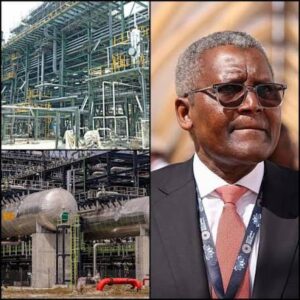
One refinery particularly affected by the limited supply is the 650,000 barrels-per-day Dangote Petroleum Refinery, which has repeatedly highlighted challenges in securing enough domestic crude.
Earlier reports indicated that the facility receives about five cargoes of crude monthly from the Nigerian National Petroleum Company Limited, far below the 13 cargoes required under the naira-for-crude arrangement meant to support local refining.
The supply gap has forced the refinery to source additional crude from international markets, often at prevailing global prices.
Officials within the national oil company previously disclosed that efforts were underway to obtain crude from third-party international traders to help sustain refinery operations while domestic supply remains tight.
Despite a slight improvement in January production compared to December 2025’s 1.422 million barrels per day, the recovery proved temporary as output declined again in February.
Nigeria has struggled to meet its OPEC production target consistently. Data from last year showed that the country fell below its quota in nine months of 2025, surpassing or matching the benchmark only in January, June, and July.
The country started 2025 strongly, producing about 1.54 million barrels per day in January, but output slipped to 1.47 million barrels per day in February and 1.40 million barrels per day in March, widening the gap with its OPEC allocation.
Although production recovered slightly in June and July, when output climbed to about 1.51 million barrels per day, the gains were not sustained as production dipped again later in the year.
As Nigeria moves further into 2026, the Federal Government expects higher output, particularly with the Dangote refinery now operating at its full processing capacity of 650,000 barrels per day.
Meanwhile, the Chief Executive of the Nigerian Upstream Petroleum Regulatory Commission, Oritsemeyiwa Eyesan, has pledged to boost production through improved operational efficiency in the upstream sector.
According to the commission, the strategy includes recovering shut-in production volumes, slowing the natural decline of oil fields, reducing operational losses, and accelerating the timeline for bringing new oil projects into production.
The government has also set ambitious targets for the sector, aiming to increase Nigeria’s crude oil production to 2 million barrels per day by 2027 and 3 million barrels per day by 2030.