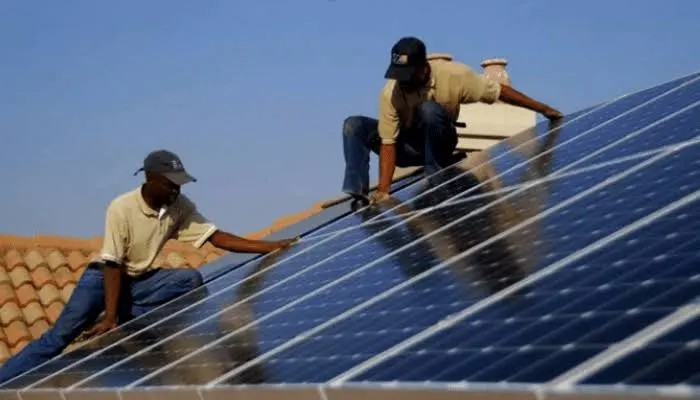
The National Board for Technical Education (NBTE) has issued a strong warning against the growing trend of rooftop solar panel installations in Nigeria, describing them as unsafe and largely unprofessional.
Speaking in an interview with the News Agency of Nigeria (NAN) in Abuja, the Executive Secretary of NBTE, Prof. Idris Bugaje, raised alarm over widespread violations of safety and engineering standards in solar installations across the country.
“The installations that are going on across the country on rooftops are very unprofessional and they are risks to fire,” he said.
“During the peak of solar radiation, the current flowing in the wires is at its highest. If the current is too high, the wires heat up due to resistance. Some can even melt. If two wires spark, it can ignite fire.
Many fires have happened because of that.”Prof. Bugaje also criticised the common practice of mounting solar panels at the same steep angles as rooftops — often 60 to 70 degrees — which he said significantly reduces solar efficiency.“For optimal performance, panels should be mounted at about 10 degrees facing south, especially in places like Abuja,” he advised.
He emphasized that while renewable energy is crucial to solving Nigeria’s energy crisis, improper installations pose serious risks. “A population of 230 million people enjoying just 5,000 megawatts is dangerously low. We cannot industrialise on that,” he said.
To address the skills gap, Bugaje revealed that the NBTE has updated its National Diploma in Renewable Energy Engineering, and introduced new Higher National Diploma (HND) programs in photovoltaic and solar thermal engineering.
Additionally, short-term certifications under the Nigerian Skills Qualification Framework (NSQF) are now available to properly train solar technicians.
He urged state governments to leverage recent constitutional amendments that now empower them to independently generate and distribute electricity, calling it a vital step toward closing Nigeria’s energy gap and tapping into its vast solar potential.