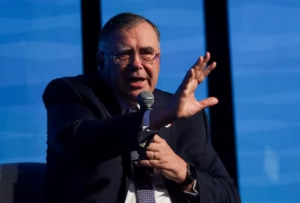
Türkiye has expanded its long-term natural gas portfolio after state energy company BOTAŞ signed two fresh 10-year liquefied natural gas (LNG) supply contracts with Germany’s state-owned SEFE and Italian energy firm Eni. Energy and Natural Resources Minister Alparslan Bayraktar announced the new agreements on Wednesday during the World LNG Summit in Istanbul.
According to the minister, deliveries under both contracts will begin in 2028. The deal with SEFE covers roughly 6 billion cubic meters (bcm) of gas-equivalent LNG over 10 winter periods, while the Eni agreement will supply about 5 bcm across the same timeframe.
With these additions, Türkiye has finalized long-term LNG commitments amounting to 106 bcm so far this year, and more than 155 bcm when including contracts signed since September. Bayraktar said the strategy is aimed at broadening energy sources and reducing reliance on pipeline imports by taking advantage of the global LNG market.
He noted that Türkiye’s investments in LNG facilities and storage infrastructure have significantly strengthened its energy security. Over the past decade, regasification capacity has increased fivefold, enabling the country to meet nearly one-third of its gas needs through LNG in certain years.
Türkiye imported around 50 bcm of natural gas last year, including 14.3 bcm as LNG. Russia remains the largest pipeline supplier, while the United States is Türkiye’s main LNG provider.
Bayraktar also highlighted Türkiye’s growing role as a regional energy supplier. Gas is currently exported to several European countries, including Bulgaria, Romania, Hungary and Greece, with LNG supplies reaching North Macedonia and Serbia. He said Türkiye is prepared to offer its terminals to European buyers seeking access to LNG through the country’s regasification network.
Beyond imports, Türkiye is increasing its international exploration activities as well. The Turkish Petroleum Corporation (TPAO) has recently signed new agreements for oil and gas exploration in Pakistan and is pursuing additional projects in Libya, Iraq and Central Asia.
Domestically, Türkiye is pushing ahead with development of the Sakarya Gas Field in the Black Sea, believed to hold 710 bcm of reserves. Production from the field is expected to gradually rise over the coming years, eventually supplying up to 30% of the country’s annual gas demand. A new 75 bcm discovery announced earlier this year will further expand reserves in the region.
Bayraktar said the first phase of the Sakarya project is already delivering gas to millions of households, with the second and third phases set to increase output significantly by 2028.