Nigeria committed about $4.15 billion and N11.35 trillion to its three government-owned refineries before 2021, but the facilities continued to struggle with prolonged shutdowns and low output, the Petroleum and Natural Gas Senior Staff Association of Nigeria (PENGASSAN) has said.
PENGASSAN President, Festus Osifo, disclosed this in Lagos on Monday while speaking on the long-running rehabilitation of the Port Harcourt, Warri and Kaduna refineries.
Osifo said the huge sums spent on the facilities over several administrations did not translate into meaningful rehabilitation, noting that workers at the refineries saw little evidence of major turnaround maintenance before 2021.
Records from the Nigerian National Petroleum Company Limited and the National Assembly show that about $4.15 billion was committed to interventions in the refineries between 1993 and 2019.
The expenditure occurred under successive governments, with allocations ranging from $520 million during the Abacha administration to about $2.39 billion under former President Muhammadu Buhari.
The National Assembly also reported that approximately N11.35 trillion was spent on refinery operations and rehabilitation between 2019 and 2029. The figure includes N4.8 trillion in operating costs, N42.65 billion earmarked for rehabilitation between 2013 and 2019, and N191.67 billion deducted from the Federation Account in 2020 and 2021.
Additional spending recorded during the period included $592.9 million, €4.87 million and £3.45 million.
Despite the expenditure, the refineries operated at below 30 per cent of their capacity and were largely unproductive from 2010.
Osifo said the rehabilitation programme launched from 2021 represented a significant departure from previous efforts. He cited the $1.5 billion contract awarded for the rehabilitation of the Port Harcourt Refinery as an example of the scale of the new intervention.
According to him, the Port Harcourt facility required extensive work, with the refinery resembling a construction site during the rehabilitation process.
He added that between 90 and 95 per cent of PENGASSAN members previously working at the facility were redeployed to other strategic business units within NNPC Ltd. while the rehabilitation was ongoing.
The old Port Harcourt refinery was subsequently separated from the new facility after it became clear that a key component required for the new plant would take about three and a half years to arrive.
Osifo explained that the older facility was capable of producing Automotive Gas Oil, Dual Purpose Kerosene and aviation fuel, although it could not produce petrol that met the required specification without additional processing.
The separation eventually allowed the old refinery to restart operations. However, subsequent assessments by NNPC management reportedly found that operating the facility was commercially difficult because the value of crude supplied to the refinery exceeded the value of the products generated.
Osifo said PENGASSAN supports efforts to bring Chinese investors into Nigeria’s refinery sector but wants the arrangement to go beyond technical or maintenance contracts.
He advocated an equity-based structure similar to the ownership model used by Nigeria LNG Limited, under which private investors would have a controlling stake while the government retains a minority position.
The union would prefer investors to hold as much as 51 per cent of the refinery equity, with government retaining 49 per cent. Osifo said this would limit political interference and encourage decisions based on commercial considerations.
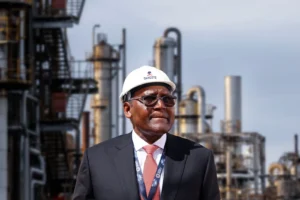
On PENGASSAN’s dispute with the Dangote Refinery, Osifo said the union had resolved issues concerning affected employees, allowing about 600 workers to return to their jobs at the facility.