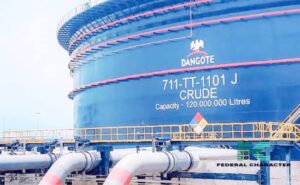
The Dangote Petroleum Refinery sourced about 116 million barrels of crude oil from Nigerian suppliers in the 12 months to June 30, 2026, accounting for roughly 60 per cent of the crude it processed during the period.
The figure was disclosed in the refinery’s prospectus for its initial public offering on the Nigerian Exchange.
The refinery processed about 26.4 million metric tonnes of crude during the period. Based on a conversion rate of 7.33 barrels per metric tonne, this is equivalent to approximately 193.5 million barrels.
Of the total volume, about 116.1 million barrels were sourced domestically, while the remaining 40 per cent came from international markets.
The refinery’s local crude supply included term contracts with NNPC Limited, including crude supplied under the Federal Government’s crude-for-naira initiative. Dangote also purchased crude through spot transactions from international oil companies and other Nigerian producers.
However, the prospectus did not specify the individual contributions of NNPC, international oil companies and other local producers to the domestic supply.
Dangote said its supply agreements provide access to as much as 350,000 barrels of crude per day, subject to availability and contractual conditions.
Despite obtaining most of its feedstock locally, the refinery continues to source crude from international markets to maintain flexibility in its operations.
As of June 30, 2026, the facility had processed 36 crude grades from Africa, South America, the United States and the Middle East.
According to the company, its economics and planning team evaluates different crude grades based on factors such as expected refined-product yields, the refinery’s configuration, operational limitations and prevailing product prices.
The refinery does not have a dedicated upstream pipeline connecting it directly to oil-producing fields. Instead, crude is transported by vessels and delivered through its offshore single-point mooring system and connected onshore pipelines.
Dangote said the setup allows it to switch to alternative crude grades when particular supplies are unavailable.
However, the company noted that its supply arrangements do not completely eliminate the risk of feedstock disruptions.
It identified supplier failures, upstream production interruptions, restrictions by oil-producing countries and security challenges in the Niger Delta as potential factors that could affect crude availability.
Dangote warned that a shortage of crude feedstock could reduce refinery utilisation, increase production costs and put pressure on refining margins.