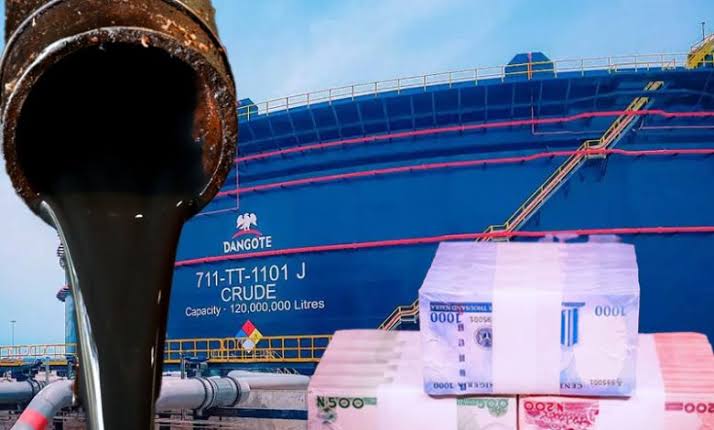
The federal government is advancing with its bold Naira-for-Crude policy, a key initiative under President Bola Tinubu’s economic reform plan aimed at stabilising the currency and enhancing energy security.
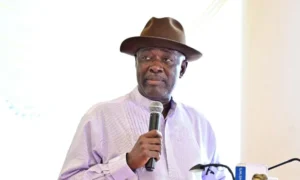
Finance Minister and Coordinating Minister of the Economy, Mr. Wale Edun, announced the progress at a meeting of the Technical Sub-Committee on Crude and Refined Product Sales in Naira held in Abuja on Friday.
“We are pleased with the level of inter-agency collaboration and stakeholder engagement,” Edun said, chairing the high-level session focused on transitioning oil and refined product transactions into local currency.
The Naira-for-Crude initiative, designed to reduce dependence on foreign exchange and boost local refining, is now moving into the next phase—refining supply chain alignment, pricing frameworks, and regulatory integration.
Key industry players were present, including Executive Chairman of the Federal Inland Revenue Service and Committee Chairman, Mr. Zacch Adedeji; Special Adviser to the President on Energy, Ms. Olu Verheijen; and senior officials from the Nigerian National Petroleum Company Limited (NNPCL), NMDPRA, NUPRC, and the Nigerian Ports Authority.
“The policy is critical to reducing inflation, strengthening local production and improving our trade balance,” Edun added.
In a parallel development, Dangote Refinery and NNPC Ltd. are reinforcing their strategic partnership to secure Nigeria’s energy future.
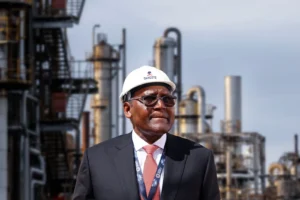
During a courtesy visit to NNPC Towers in Abuja, President of Dangote Group, Alhaji Aliko Dangote, made it clear there’s no rivalry with the state-owned oil giant.“There is no competition between us. We are not here to compete with NNPC Ltd,” Dangote stated.
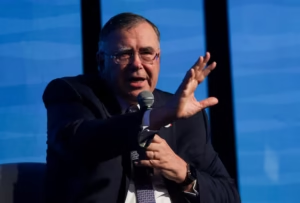
“This is an era of co-operation between the two organisations.”Responding, NNPC GCEO Mr. Bashir Bayo Ojulari emphasized collaboration over competition:
“We are building a legacy of national prosperity anchored on innovation and shared purpose.”Both sides affirmed that commercial collaboration, especially in refining and distribution, is crucial for Nigeria’s economic future.