Nigeria has strengthened its footprint in the global energy market with the unveiling of a 40,000-cubic-metre Liquefied Petroleum Gas (LPG) carrier, jointly owned by the Nigerian National Petroleum Company Limited (NNPC Ltd) and Sahara Group.
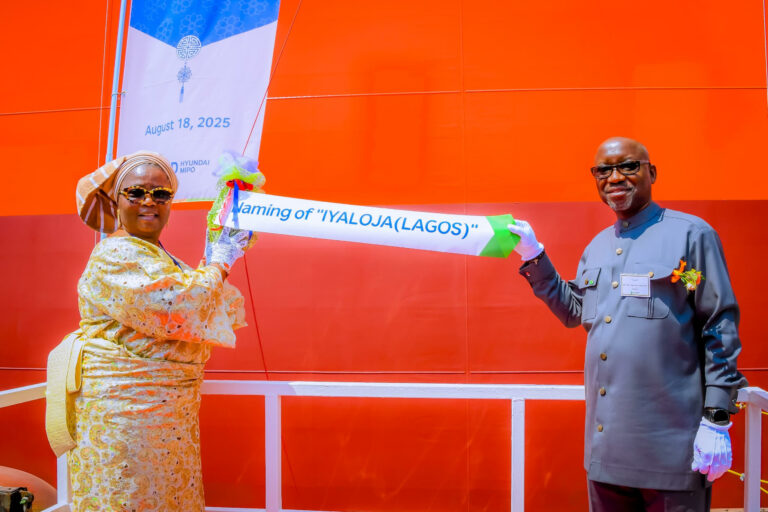
The vessel, christened MT Iyaloja (Lagos), was inaugurated on Monday in Ulsan, South Korea, at a ceremony attended by government officials, industry leaders, and the Iyaloja-General of Nigeria, Alhaja Folasade Tinubu-Ojo, who performed the symbolic ribbon cutting.
Representing President Bola Tinubu at the event, Minister of State for Petroleum Resources (Gas), Ekperikpe Ekpo, said the launch reflects Nigeria’s determination to deliver sustainable and cleaner energy solutions domestically, across Africa, and globally.
WAGL Energy Limited — the joint venture company between NNPC Ltd and Sahara Group — now operates five LPG carriers with a combined capacity of 162,000 CBM. Other vessels in its fleet include MT Africa Gas, MT Sahara Gas, MT BaruMK, and MT Sapet. Over the past five years, WAGL has delivered more than six million metric tonnes of LPG across West Africa.
Group Chief Executive Officer of NNPC Ltd, Bashir Ojulari, described the new vessel as a strategic addition to Nigeria’s gas development efforts. Speaking through the company’s Executive Vice President for Gas, Power & New Energy, Olalekan Ogunleye, he emphasized that NNPC remains committed to expanding LPG availability and ensuring affordability nationwide.
Temitope Shonubi, Chairman and Executive Director at Sahara Group, said the commissioning highlights the company’s commitment to bridging Africa’s energy infrastructure gap. He added that naming the vessel after Alhaja Abibatu Mogaji, the late mother of President Tinubu, was a tribute to her legacy of empowerment and progress.
WAGL’s Managing Director, Mohammed Sani Bello, disclosed that the company plans to expand its fleet further within two years, with the addition of both a Small Gas Carrier and a Very Large Gas Carrier.
The commissioning of MT Iyaloja (Lagos) underscores Nigeria’s broader ambition to play a stronger role in the global clean energy value chain while boosting access to LPG across Africa.