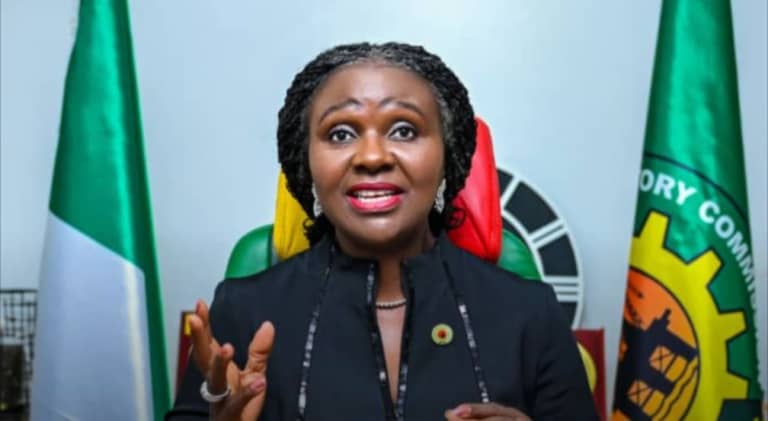
Inconsistent regulatory frameworks across African nations are discouraging investment in the energy sector, the head of the Nigerian Upstream Petroleum Regulatory Commission (NUPRC) has said.
Oritsemeyiwa Eyesan emphasized the need for stronger collaboration among African petroleum regulators to harmonize policies and boost cross-border energy projects.
Speaking at the Nigerian International Energy Summit at the International Conference Centre in Abuja, Eyesan highlighted that Africa’s energy challenges today are less about resources and more about fragmented regulations that increase costs, delay projects, and deter investors.
She was represented at the event by NUPRC Director Edu Inyang.
“Investors are not turned away by Africa’s geology; they are discouraged by inconsistent rules,” Eyesan said. She called for a stronger African Petroleum Regulators’ Forum (AFRIPERF), describing it as a platform designed to drive regulatory convergence, improve predictability, and accelerate cross-border oil and gas projects.
Since its launch, AFRIPERF has been working on aligning technical standards, creating shared data platforms, building regulatory capacity, and projecting a unified African voice at global energy and climate platforms.
Eyesan said such efforts are crucial to unlock Africa’s industrial and economic potential.
“Africa possesses eight percent of the world’s oil and gas reserves, nearly 30 percent of critical minerals, and over 1.5 billion people – most young and economically active. Coordinated policies and aligned regulations can transform these advantages into industrial growth, energy security, and inclusive development,” she noted.
Despite the global shift toward renewable energy, Eyesan stressed that oil and gas will remain key to Africa’s development for decades, supporting electricity, clean cooking, fertilizers, petrochemicals, and public revenues. She cited Africa’s growing influence at international forums, including the recognition of gas as a transition fuel and the creation of the Loss and Damage Fund at COP27.
Eyesan pointed out that fragmented regulatory regimes have left more than 180 trillion cubic feet of discovered natural gas untapped. She urged African regulators to expand regional gas and power networks, adopt common sustainability standards, and maintain a unified stance in global energy discussions.
Highlighting Nigeria’s role, she cited the Petroleum Industry Act 2021, transparent licensing rounds, and major gas infrastructure projects such as the Ajaokuta–Kaduna–Kano pipeline and the revived Trans-Saharan Gas Pipeline. She also noted the Africa Energy Bank, headquartered in Nigeria, as a critical vehicle for mobilizing continental investment in energy.
“Our voice must be unified, our regulations aligned, and our actions coordinated. Only then can Africa’s resources fully drive growth and prosperity for our people,” she said.
AFRIPERF, established by African petroleum regulators, continues to work on harmonizing regulatory standards, building capacity, and improving the continent’s attractiveness to energy investors.