Nigeria’s oil and gas sector has recorded a major rise in indigenous participation, with the number of operating companies increasing from fewer than 10 before local content reforms to about 117 today. Industry stakeholders say this growth shows how government policies are reshaping the energy sector and creating more opportunities for local businesses.
The development was highlighted at the 2026 Nigerian Oil and Gas Midstream and Downstream Summit in Lagos, where regulators, lawmakers, and investors reviewed progress in building stronger local capacity across refining, gas processing, petrochemicals, and related services.
Officials of the Nigerian Content Development and Monitoring Board said local content performance has improved significantly, rising from less than 5% in 2010 to about 61% in 2025. They also noted that the expansion has created nearly 12,000 jobs across different segments of the industry.
At the summit, Patrick June, who oversees midstream monitoring at the board, said the growth reflects increased involvement of Nigerian firms across the oil and gas value chain. He explained that thousands of service companies, engineering firms, fabrication yards, and manufacturers are now actively contributing to the sector.
The Executive Secretary of the board, Felix Ogbe, said the industry is undergoing a structural shift driven by reforms, clearer policies, and rising investor confidence. He noted that Nigeria is gradually moving away from heavy dependence on crude oil exports toward more local refining and value addition.
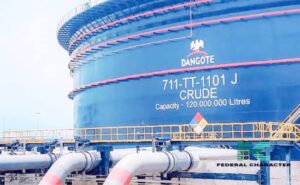
He pointed to the Dangote Petroleum Refinery as a key example of the country’s growing refining capacity and industrial ambition, adding that such projects are helping to reshape the oil and gas landscape.
Lawmakers also stressed the importance of strengthening local content. Chairman of the Senate Committee on Petroleum Resources (Midstream and Downstream), Kawu Sumaila, said the sector is central to Nigeria’s economic future and must deliver real industrial capacity, not just regulatory compliance.
He added that while the Petroleum Industry Act has improved transparency and investment conditions, stronger collaboration is needed to ensure that Nigerian participation goes beyond paperwork into real technical and operational control.
The Nigerian Midstream and Downstream Petroleum Regulatory Authority also said the sector has attracted significant investment in recent years, especially in gas infrastructure, storage, and processing facilities.
Stakeholders at the summit agreed that Nigeria is steadily transitioning from a crude oil export-dependent economy to one that increasingly processes and refines its own energy products, with local content policies playing a major role in that shift.